
Honey Grove, Texas, United States
July 12, 2024
8:43 PM (CST)
4 hours after The Blink
Ryan tapped his pen against the empty lines of his notebook while the people of Honey Grove argued over whether or not the world had ended.
Town hall’s main meeting room was spacious and open, filled with the works of local artists hanging on the walls and on displays that made it look more like an art gallery than a government building. A raised platform against the back wall supported a simple wooden podium in front of a Texas state flag and various Fourth of July decorations that would most likely stay up until late August. In front of the platform, rows of metal chairs reached all the way back to the front doors of the building.
Or they had when the meeting started. Once the room began filling up, the chairs were pushed to the far sides of the room to provide more space for people. Now there were close to three hundred people crammed inside, with more lined up on the sidewalk hoping to see what was being said through the windows.
They were the lucky ones, in Ryan’s opinion. They at least had fresh air and space to breathe out there. Inside, standing fans did nothing but move the sour smell of sweat and fear around the room; the smell was almost more oppressive than the collective body heat radiating off of so many people in one enclosed area. And to top it all off was a droning roar that rivaled that of college football stadiums, a blended shouting match of voices all trying to argue louder than their neighbors, as if their point’s validity was based solely on volume.
So far, the gathered crowd had only been able to agree on one thing: the Sun was no longer shining over Texas.
“Folks, please,” Mayor Glenn Howell said yet again into his microphone. Standing behind the podium, the mayor had already tried several times to regain control of this renewed wave of shouting but was so far unsuccessful. Sweat ran down his face and stained the collar of his dress shirt, either from the faltering A/C units or the stress of being in charge of a situation for which there was no protocol. He stared out at the crowd with a distant, haunted expression on his face, like he expected to wake up from this nightmare any minute and find a sunbeam resting against his cheek. Ryan figured his own face had that same detached look of fear and denial, the same desperation that it would all go back to normal if he could just open his eyes. Everyone’s faces did.
The problem was one of information. People were afraid, understandably, but nobody up top had told them they didn’t need to be. Outside of the Emergency Alert Broadcasts that infiltrated TVs around the nation, no facts had been provided by a single government agency. Those broadcasts, with their screeching siren and robotic voice emotionlessly informing citizens to shelter in place until further notice, had done more to terrify the people of Honey Grove than reassure them. As if this were no different than a wind advisory, the broadcast stated that an “Extreme Solar Event” had taken place (whatever that meant) and that more information would follow shortly, but in the four hours since the broadcasts started there hadn’t been any information added, no press briefings from the President or NASA, just total radio silence.
Ryan thought the silence was the scariest part of all of it. The government wasn’t even lying about what had happened. No swamp gas or weather balloon excuses, nobody trying to explain away what had happened to the Sun, nothing. If some well-dressed man in a suit had stood before a hundred cameras and lied through his teeth to everyone in the world, Ryan would have felt better. That would have at least felt normal. Silence meant the people up top were just as shocked and confused as everyone else, which meant they really had no idea what was going on, and that was almost more terrifying than a sky without a Sun.
With no official updates, people were beginning to invent their own narratives to explain the unexplainable, latching onto the first social media post or blog article that offered to make the dark not seem so scary. Which was to be expected, Ryan knew that much from living through the last decade. But it was nothing new, not really. Humans had been doing it since the very beginning, inventing lightning bolt-wielding gods to offer an explanation for the sudden explosions in rainstorms or legends of giant beasts swallowing the Sun to explain solar eclipses. The unknown has always been humanity’s greatest fear, but it’s not all that different today than it was five thousand years ago. Just easier to spread the comforting falsehoods around the world. That was why journalism—good journalism—was so important to have in a healthy society. Being able to separate fact from fiction allowed people to move beyond their fear and focus on the truth, on their lives, and this was only possible if someone was willing to question what they had heard and start looking for answers.
Although he had only been working as a reporter for a few weeks, Ryan hoped he could one day say that his words had had this effect on someone, that one of his articles had banished fear and inspired hope in the mind of at least one other person. It was the reason he had wanted to become a journalist in the first place, why he had moved halfway across the country to accept the first position that accepted his application. And it was why he had answered the phone when the Herald‘s editor asked him to cover Howell’s emergency meeting.
Well, that wasn’t entirely true. Cheri had called Ryan, but she hadn’t assigned him to the meeting. In fact, she hadn’t assigned anyone to it.
“The Herald is canceled,” she had told him before he had finished saying hello. “Javi and Veronica won’t return my calls and Joanne texted that her family is heading up to their cabin until this blows over. In other words, we don’t have enough writers to keep the paper going. If I were you, I’d head back to Florida before the interstates get too bad.”
Ryan was stunned. Was she serious? At that point it had only been about an hour since the Sun went dark, far too early for people to declare that the apocalypse had arrived. “It’s not the end of the world,” he’d said, the anger in his tone surprising himself more than it did Cheri. He took a breath and tried again. “Whatever this is won’t last forever, it can’t, and in the meantime people need to know what’s going on locally.”
“I agree, but we don’t have the resources to give it to them right now.” Sherry sighed. “Look, I know you’re excited to get your literary feet wet, but now isn’t the time for it. You can have the front-page story on all this when we reopen, I promise. You may be new, but I really do think you have potential. Plus you’re the only one who actually answered the phone. That’s worth something in my book.”
“Then let me cover the meeting,” he begged. “I’ll have a full article ready for print before noon tomorrow. Or we could run an online article—”
“Ryan, no. Go to the meeting and take notes if you want, but the Herald‘s doors will be locked until further notice. I’m sorry. I have to go.”
Ryan had tried arguing with her but realized after a few words that she had ended the call. He had almost lost it then, standing there in the dark of his living room surrounded by some half-burned Christmas candles he’d found in a kitchen cabinet, no lights, no power, probably no job now that he’d picked a fight with his boss. His bedroom was destroyed—desktop computer now a scrap heap, bookshelf splintered and surrounded by the corpses of his favorite books, and in his crushed bed slept the front half of a two-ton Toyota. Through his windows he could hear the sounds of car doors slamming as neighbors loaded everything they could into the backseats, as if they could catch up to the Sun if they could just drive long enough.
But this wasn’t something you could run away from, Ryan thought. It was global. As much as he believed it would come back, right now the Sun was gone. He and everyone else on the planet had watched coverage of the event newscasters were referring to as “The Blink.” Without a working TV, Ryan had sat in the dark on his couch and watched videos on his phone of people who had filmed the Sun’s final moments. Each one was the same as the last, the only difference the backdrop. They started with the round disc of the Sun deforming from the top down, morphing from a perfect circle to a semi circle, then to a shrinking crescent that reminded Ryan of the Cheshire Cat’s toothy grin hanging there in the sky, then to a sliver no thicker than a clipped fingernail, and then to nothing at all.
Like an eyelid slowly blinking shut.
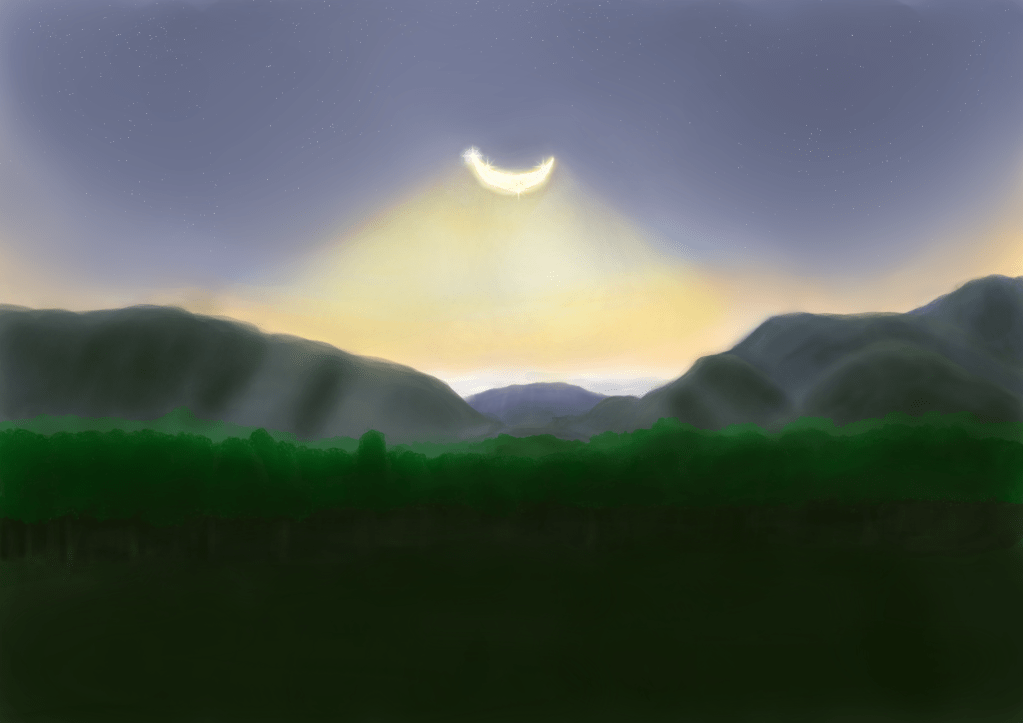
Ryan had gone down the various rabbit holes of the Internet in search of more news, but he had found only wild conspiracies and doomsday comment threads that made his heart pound in his throat. Thousands of videos of The Blink circled the globe within minutes as people shared what they’d seen to social media, but the wildest thing was the faked videos that began spreading. Clearly edited clips showing a man in white robes stepping out of the Sun before it vanished, CGI’d alien ships descending on the world and destroying cities, ghostly voices chanting in Arabic from the sky, the list went on. Ryan didn’t get it. There were real, actual videos of the Sun disappearing out of the sky and people were rejecting them in favor of obvious fakes. It was crazy.
And from the way Howell’s emergency meeting had gone so far, crazy was very quickly rising to the forefront of peoples’ minds.
Ryan clicked his pen let its tip hover over the blankness. The pages, thick and smudge-proof, were lined with dots rather than solid lines, but most useful was that additional pages could be “loaded” into the leather cover as needed. He’d gotten the journal as well as four notebooks worth of replacement pages from his grandparents as a going away gift last month, and he loved everything about it. It was the kind of book you felt nervous about writing in, the kind you leave in a drawer and plan to use but never do for fear of ruining its beauty.
Ryan’s pen began scratching across the page.
Town hall was filled to beyond capacity Friday night evening (?) as the people of Honey Grove looked to Mayor Howell for leadership following the mysterious bizarre disappearance of the Sun.
It was a decent opening, he thought, despite the crossed out words. Obviously still needed some fine-tuning, but it was a good enough place to start. Writing the words “disappearance of the Sun” had almost felt too ridiculous to put to paper, but what else could he call what happened?That was about as truthful as he could get on the matter. And Ryan wanted this article to be the clearest representation of the truth, because right now that was what the people of Honey Grove needed most. The pressure to write a story that people would not only read but also learn from had been steadily building over the last two hours, ever since he had grabbed his notebook and pen and headed out the door for the meeting.
What started like any other meeting quickly turned devolved into chaos as questions unanswered by top minds leading scientists remain unsolved, leaving the people of Honey Grove Texas, and the world at large, truly in the dark.
Ryan chewed at the end of his pen. Every article needed a bit of wordplay, right?
Mayor Howell slammed his hands down on the podium hard enough to crack its wooden surface, the sound echoing like a gunshot through the room. “That’s enough!” The crowd fell silent, every face turning toward their otherwise mild-mannered mayor. “Now, if we can’t do this like civilized people, we’re not gonna do it at all. I’ll end the meeting right now and you can all go home and figure it out on your own.” He waited, eyes moving across the people before him as if begging someone to say something. No one did. “Alright. Let’s get this thing back on track. Who has the mic?”
The microphone, found on the floor where it had been forgotten once people had realized shouting was a much quicker way to be heard, passed from hand to hand until it came to a man standing at the front of a group in the middle of the room. Several groups had broken away from the once unified crowd, but the man with the mic belonged to the largest of these by far. He looked to be in his forties, a short, stocky man dressed in camo pants and an olive green shirt that looked about two sizes too small. Despite not having a need for them, a pair of sunglasses dangled from a cord around the man’s neck.
“Darren,” Howell said, gesturing to him, “you have the floor. What’s your question?”
Darren took the mic and switched it on. “My question is what you’re planning on doing to keep the town safe while all this is going on.”
Howell nodded, slipping back into the role of politician without hesitation. “I can assure you, Honey Grove is in absolutely no danger at this moment. Our grocery stores are fully stocked and between the two gas stations in town, fuel will not be—”
“I’m not talking about supplies,” Darren cut in. “I’m talking about safe. Secure. From enemies foreign and domestic.”
The mayor glanced around the room, waiting for some indication that this was a joke, but nobody laughed. The people surrounding Darren only nodded in agreement with him. “Sorry, Mr. Turner, but I don’t know what you mean.”
“I mean Russia. Or China. Korea.” Darren said. “People are saying this is the first step in an attack on U.S. soil. A distraction to keep us all looking up at the sky while they send in troops.”
“Well,” Howell said carefully, “I haven’t heard any official reports about that, but I can assure—”
“Well you won’t,” Darren said. “The media’s keeping it all quiet so we won’t have the chance to prepare. That’s why the news isn’t covering it. We need to be ready.”
Ryan frowned and stopped writing. He knew he had a duty to be an unbiased and professional journalist, especially at a time like this, but he also wanted nothing more than to ask Darren—
“How the hell did you hear about it, then?” The voice belonged to a woman toward the back of the room. Ryan bit back his smile and looked for her, but there were too many people in his way.
Darren’s jaw muscles tightened but he ignored her question. “We need a plan in place in case someone starts parachuting in soldiers or dropping bombs.”
The woman fired back at him, her voice audible even without a microphone. “This isn’t Red Dawn. We need to worry about what’s actually happening, not YouTube conspiracy theories.”
“One at a time, Miss Rivera,” Howell warned. He turned his attention back to Darren. “I have every confidence that our military can defend us against any threat that might come our way. Besides,” he gave a rehearsed little laugh and flashed a too-white smile, “I’m willing to bet we have more guns in this room than all the military bases outside Texas. I think we’ll be just fine, Darren. Next question?”
The microphone reluctantly made its way out of Darren’s group and to a more scattered one to the side of the room, where it ended in the hands of a younger man no older than twenty. The rising chatter of the room died down as he cleared his throat. “I don’t think we need to get ready for war,” he said nervously, gaining a few nods from around the room that seemed to raise his confidence. “We need to attempt to respond.”
Ryan again stopped writing, knowing exactly where the kid was going with his thought.
Howell, clearly unfamiliar with the Internet theories Ryan had read through a few hours earlier, shook his head in confusion. “Respond?”
“It wasn’t natural,” the kid said, voice low. “I saw it. Didn’t you? The Sun didn’t just go out, something moved in front ofit, some kind of giant round thing. What if it was a ship? No, wait, just hear me out. Shouldn’t we try to say something to them so they know we see them?”
The people who had been nodding with the kid seconds earlier immediately stopped. Howell didn’t attempt to hide his laugh, but motioned for him to pass the microphone on. “I don’t think aliens did this, son, but if they did, I’m sure NASA has already sent them a greeting card.”
The microphone embarked on another journey around the room, stopping briefly at more islands of insanity before sailing off to the next in line. People discussed setting up an armed guard to patrol Honey Grove, contacting the National Guard to request soldiers, even blocking the highways leading into town just in case, and Mayor Howell shot down each of these ideas with a surprising amount of patience.
Ryan held his hand up several times as the microphone traveled, but it never came his way. Howell saw him, he had to have, but not once did the mayor make eye contact or tell the people to pass it to him. This would have bothered Ryan if he’d had any questions worth asking, but truth be told he didn’t. Howell had already “answered” some similar ones asked by other people in the room, though his response always came in the form of considering the question for a moment and then simply saying, “We’ll just have to wait on an official update to really know. Next?”
Near the end of the meeting, the microphone came to an older lady with thick glasses and a puff of white hair. She stood in another group of people, not quite as large as Darren’s but probably a close runner up. “Yes, I only wanted to take the time to invite everyone to come down to the church for our potluck dinner when this meeting ends.” She smiled. “We will be keeping our doors open and lights shining bright for as long as we can, all the way up until the Sun’s return.”
Ryan thought this was a very nice and optimistic outlook on the day until the people of her group let loose a chorus of enthusiastic amens, and then he realized she had said “Son’s return,” not “Sun’s.”
Surely there was at least one other person in Honey Grove who expected daylight to return without an apocalypse. Out of everyone who had a turn at the microphone, the sanest person in the room so far seemed to be the kid who wanted to send smoke signals to the alien ship blocking the Sun. At least he had formed a theory from what he had witnessed with his own eyes, crazy as that theory was.
The microphone bounced around the room for another half hour, landing at people with various concerns and ideas for what the town should do. Some were rational, such as questions about if martial law would be imposed (“Not in Honey Grove, but let’s be smart about things. Next question.”) and operating hours for the town’s grocery store (“Up to the store owner. Next.”). There were a few more irrational concerns as well, such as one older man who used his time to state that the President, who he knew without a doubt to be behind the Sun’s disappearance, should be hanged as soon as possible for his crime. Another began rapidly reciting verses from Revelation until the microphone was taken from him by a town hall security guard. One woman asked if laws still applied in the state of Texas, which roused a good bit of suspicion toward her from the others in the room. But overall, the meeting came to a close peacefully but, in Ryan’s view, unsatisfactorily. Not much had actually been answered, and Howell had spent half the time glancing down at his phone, patience clearly running thin.
“Alright,” he eventually said, clapping his hands together. “How about we wrap this up for the night? If it’s still dark by sunrise tomorrow morning, we’ll hold another meeting to start thinking about—”
“Excuse me?” The same woman who had confronted Darren was now waving her arm in the air. Ryan could see her now and he was shocked to find she was in her mid-forties, streaks of white in her black hair, far from the beret-wearing, fist raised in the air college student he had pictured when she first spoke out.
Howell sighed. “Yes, Miss Rivera?”
“Oh, good, you can see me.”
In the crowd, Darren snorted. “Can hear you, too, unfortunately.” Several people laughed.
“Do you have a question?” Howell asked.
“Yeah,” Rivera said. She still didn’t have a microphone but that didn’t stop her voice from carrying throughout the large room. “What are you planning to do about the cold?”
Howell smiled and looked around. “Miss Rivera, it is currently in the high 90s.”
“Currently,” she emphasized. “But if the Sun really is gone, it’s not going to stay that way for long.”
“As I’ve said before, we don’t know that the Sun is gone. This might just be another eclipse like the one we had a few months ago. You remember that, I’m sure. It got dark over the whole town, just like this, but the Sun came right back after a while.”
“Less than a minute later,” Rivera said, then shook her head. “This isn’t an eclipse. Those aren’t this dark and they don’t last for four hours. If the Sun’s really gone, we have a very small window of time to prepare before the world starts getting cold. And I mean very—”
“Hold on a minute,” Darren turned to face her. “If memory serves, last time you came to a meeting all you did was bitch and moan about the world being too hot.” He looked around and grinned. “Sounds like your problem’s solved, Doc.”
More people laughed, but Rivera’s eyes glowed with a heat that could have melted steel. When she spoke, her voice was calm and steady. “The last time I came to a meeting, the Sun was still in the sky. I’m sure even you can understand that the Sun warms the Earth.”
Darren only smiled back at her. “I can understand how those solar panels on your roof work, and I can understand what it means for your batteries when the Sun don’t shine. Bet you regret going green, now, huh?” The people in his group erupted in laughter.
“Okay, Darren, that’s enough,” Howell called out over the returning chaos of the room. He looked up from his phone. “This meeting is over. We’ll meet again tomorrow at two.”
People began wandering toward the doors at the back of the room, their voices rising again in volume, though not in anger. Ryan glanced down at his notebook, at the mostly useless lines of text that covered the page. He’d written down most of what people had said, but even so there wasn’t much to make an article out of. At least not anything substantial.
Howell gathered his things from the podium and started toward a hallway at the side of the room. Heart pounding, Ryan saw his final opportunity to get a few noteworthy quotes before the day was done. “Excuse me,” he called, following after him.
The mayor didn’t stop walking. “Yes?”
“Care if I ask you some questions for the paper?”
Howell frowned at him. “What paper?”
“The Herald. Here in town.”
“Cheri told me she was temporarily shutting down.”
“She is, but she said I could write a story on what’s happening,” Ryan said, which wasn’t really a lie.
“Good for you,” Howell said, “but I really don’t have time for . . .” His gaze shifted behind Ryan and he groaned. “Oh, you’ve got to be kidding me.”
Rivera walked past Ryan like he wasn’t even there and jabbed a finger at Howell. “People are going to die if you don’t get your shit together.”
“Language. And how many times do we have to go through this same conversation after a meeting?”
“As many as it takes for you to start listening.”
Howell glanced down at his phone, sighed, and began typing something. He spoke as his thumbs moved, voice distracted and uneven. “I will hear . . . whatever concerns you have . . . at tomorrow’s meeting, but right now I’m . . . very busy.”
“With what?” Rivera demanded.
Howell’s thumbs paused and his head snapped up, lip twitching. “Look around you! The whole town is coming apart at the seams! People are packing up and leaving, I’ve got over a dozen car accidents all over town, and half the rescue squad won’t even answer their phones.” He held his own phone up for her to see and Ryan caught a glimpse of what looked like an electronics store, its windows shattered and displays empty. “That’s Al’s Computer Corner,” Howell said. “Apparently someone broke in half an hour ago and robbed him blind. I can’t get in touch with any of our police officers to investigate it so I’m instead sending two of town hall’s security guards.” He lowered his voice and shook his head. “They’re glorified mall cops, for Christ’s sake, not detectives. I know you and Darren don’t see eye to eye on most things, but he may have been on to something about calling in the Guard. We don’t have the manpower to deal with what’s happening, and I fear it’s only going to get worse. If people start looting the necessities . . .”
Rivera’s shoulders dropped. “That was fast.”
“Yeah,” Howell agreed. “People are starting to panic, and panic leads to irrational behavior. So you telling the whole town that we’re all going to freeze to death isn’t exactly helping.”
“Even if it’s the truth?”
“Especially if it’s the truth,” he hissed. “The town needs to feel safe right now. Not terrified.” He shook his head, eyes drifting back toward the now empty town hall room. “It felt like we were preparing for war during that meeting, not nightfall. Now please, I’m wearing about ten different hats as it is and I don’t have time to play Q&A with the two of you. Go home.” Howell turned and disappeared down the hallway, ignoring Rivera as she called after him.
She sighed and crossed her arms after he was gone, then glanced back at Ryan as if noticing him for the first time. “Sorry, who are you?”
Ryan closed his notebook. “I’m a reporter. Or I was when I woke up this morning.” He pocketed his pen and rubbed his face. How was it only 9PM? It felt like it was going on two in the morning.
“You write for the Honey Grove Herald?” Rivera asked.
“Technically no,” he said, “at least not yet. I’ve only been in town a few weeks, and I spent most of that time being a glorified errand boy for the actual writers. Now they all think the world’s ending and ran for the hills, so lucky for me I’m the only one left at the Herald who can write anything. Unlucky for me, though, I have no idea how to even start writing about this.”
“Have you written any articles before?”
He nodded. “A few for my grad school newspaper. Mostly about whatever flashy event was going down on campus. Easy stuff. Not–” he glanced toward the doors “–this.”
She studied his face for a few seconds, gears turning behind her dark brown eyes. “What would you need to write the story?”
Ryan shrugged. “Half an hour with Howell? Just enough time to ask a few questions and get some straightforward answers, anything to give this town at least some idea of what’s going on so they’re not so afraid. But I don’t think that’s going to happen any time soon.”
“It’s not.” Rivera said, like she knew firsthand that the mayor wasn’t the type to waste time with news interviews. A small smile tugged at the corner of her mouth. “But what if you interviewed me?”
“I appreciate the offer,” Ryan said, genuinely touched by her willingness to help him, “but I can’t just interview random people off the street. I have to use people with relevant credentials, government officials, that kind of thing.”
“Oh.”
“Nothing personal,” Ryan quickly added. “I just don’t think my editor would be too happy if I brought her a story that didn’t come from a quote unquote reputable source.”
“Right, of course,” Rivera said, but there was something in the way she said it, like someone waiting for the punchline to sink in after telling a joke. And she was looking at Ryan like he was the one who still didn’t get it.
He smiled uncomfortably and tilted his head. “What am I missing?”
She reached for the small backpack around her shoulders and shrugged. “A more feminist upbringing, maybe?” A few seconds passed while she dug around for something, then pulled out a laminated card on a lanyard and held it up for Ryan to read.
Oh. Oh. He had never felt more stupid in his life.
Dr. Katherine Rivera, professor of astrophysics and climate science at the University of North Texas, returned the ID badge to her bag and smiled at Ryan’s dumbstruck expression. “So how about that interview?”
 The Blink