
Honey Grove, Texas, United States
July 17, 2024 | 2:29 PM | 42 degrees
6 days after The Blink
Unknown to everyone, time passed.
Hour hands made their usual rounds on classroom clocks, oblivious to their own uselessness but ticking onward nevertheless. Nights blurred together with no signs of the passing of morning, midday, evening. Those who paid attention might have noticed the wheel of constellations rolling in the sky and assigned some temporal meaning to them. Orion is on the western horizon, must be close to dinner time. The turning of the stars was the only natural indication that time still existed at all.
That, and the cold.
Carlos’ meticulous weather observations were hardly needed to see that it was rapidly getting colder. The temperature had stayed in the upper fifties following the fish fry, but over the next few days it had quickly dipped into the forties. As the mercury continued to drop, though, the number of people staying at the school began to grow. Most new arrivals consisted of those who had tried remaining in their homes following the outage but found it too difficult to manage. Not everyone had a generator to keep the lights on. Those who did found they couldn’t keep them fueled for long, especially when Honey Grove’s only two gas stations were officially closed to the public. If someone wanted to fill a gas can they had two options: confront the wannabe soldiers hefting assault rifles around the Valero by the interstate, or come to the high school.
It wasn’t a difficult decision.
Howell had convinced the owner of the little Mobil station near the center of town to open his pumps for the school, which meant there was more than enough fuel to keep the generators going. Plus the added bonus of all the food and medicine from the station’s shelves. With gasoline no longer an issue on the to-do list, the mayor shifted his attention to the next coming crisis: water.
Which was the point of the meeting he called in the library. It was a small gathering this time, more for the advice and expertise of plumbers and water engineers, anyone who might prove useful in securing the school’s necessary water supply.
“The tower’ll last a while,” Jeanette Mitchell said. She was in her forties, a short-haired woman with large glasses who worked in the new water treatment plant out in Leonard, which made her the closest thing the school had to a water expert. “They’re all gravity fed, so as long as there’s water in the tank the faucets will work.”
Dr. Rivera tapped her pencil on her notepad. “What about the cold?” She was so, so tired of asking that question, but no one else wanted to.
“Most water towers have some kind of winter insulation built in,” Jeanette said, then shrugged. “I don’t know how good that’ll be if we go subzero though.”
Which we will, Rivera thought but didn’t say. Everyone still talked about the cold like it was hypothetical, something that only might happen in the distant future. It didn’t matter that it was already ten above freezing outside or that that number constantly lost a digit every few hours. She started to ask a follow-up question when Howell interrupted her.
“So what happens if we do?” There was a brief pause of emphasis on the word “if.” He cast a warning glance at Rivera as Jeanette considered the question. Don’t get all doomsday, the look said. He’d pulled her aside before the meeting and told her to speak carefully, that the goal was to solve a problem and not scare people into hopeless inaction. Those who started to see a coming disaster as unstoppable, he had said, would eventually stop trying to find ways to beat it.
Rivera was well aware of this. In fact, she had written several papers on the phenomenon throughout her career as a climate scientist. There was even a word for it: eco-paralysis. It was the helpless feeling that came from seeing the climate continuously shift for the worse, of seeing evidence all around you that weather patterns were changing, storms growing worse, droughts getting longer, wildfires burning across the planet at an unprecedented rate and covering skies half a world away with rust-tinted smoke. It was despair at seeing impoverished third-world nations without the resources to weather these changes taking the full brunt of the damage despite being the least responsible for it. It was rage at knowing that those who were responsible would never admit to that fact and, perhaps even more maddening, would never do anything to change it so long as the profits kept rolling in. It was a feeling that lurked in the mind of every forward-thinking person with the foresight to roll the tape forward a couple decades and imagine how much worse things might look in the future. The fact that Mayor Howell, a man who had repeatedly denied the existence of man-made climate change and even held town hall meetings referring to it as a “leftwing hoax,” had mansplained this idea to her was almost enough to make her turn around and walk out the door.
But she didn’t. She couldn’t.
“Well,” Jeanette said slowly, “some water towers have built-in heating units to prevent freezing, but even if ours did it would need to be powered. And that might not even matter if the ground pipes freeze.”
Joey, the kid who was on inventory duty when he wasn’t trying to keep up with the mayor’s constant running around the school, scribbled down her words in a pocket-sized notebook.
Howell gave him a second to finish and then returned to his questioning. “What about snow? Once it gets cold enough I assume it’s going to start snowing, right? Could we use that as a reliable water source?”
Jeanette nodded. “That could work.”
“It won’t,” Rivera said, rubbing her face. She did her best to hide her frustration and remind herself it wasn’t their fault for not understanding how the details of the natural world worked. She had studied them for decades, gotten a PhD in it, spent every moment chasing one ecological riddle after the next until it had been answered and the next one presented itself, the pursuit of answers a lifelong game she couldn’t quit playing. The people in this room lived regular, non-scientific lives, lives where not every question needed to be answered or even asked. She was the outlier here, not them.
“Care to elaborate, Doctor?” Howell’s voice. She didn’t have to look at him to feel the warning glance he undoubtedly threw her way.
“The water cycle,” Rivera said. “It’s built on three main processes: condensation, precipitation, and evaporation. That last one is officially over now that the Sun’s gone, which means the whole cycle is over. Without liquid water turning into water vapor, eventually we won’t have any clouds. No clouds means no precipitation. We’ll probably get snow for a while, maybe a few weeks, months, I don’t really know. But eventually it will stop.”
The mayor sighed. “Okay, so that’s a no for snow.”
“The lake,” Jeanette suggested. “Larger bodies of water hold onto heat longer than land does, right? So it will take a long time for it to freeze over.”
Yes, but eventually it will freeze over, Rivera thought, and then what do we do? Why couldn’t they think further into the future? It was like they were intentionally pretending things wouldn’t get any worse than they were now, ignoring everything she had told them so they could act like everything was alright.
Everything is not alright! she wanted to scream. It will never be alright again.
“Would it be possible to set something up at the Leonard plant?” Howell asked. “Some kind of water heater or something, then we pump the hot water into town to keep pipes from freezing.”
“It might work,” Jeanette said, “but that would go through fuel fast. Not to mention pipes freezing over here when the hot water cools.” She snapped her fingers. “Unless we set up heating stations along the pipeline. We could rig up wind turbines to keep them all powered—”
Rivera abruptly stood up and pushed her chair back. She swayed forward and reached a hand toward the round library table, fingertips supporting her weight as the room tunneled into black static. Points of light flashed in the shrinking darkness of her vision like stars popping against the night.
Or snow.
She was going to vomit.
“I need a break,” she said, voice a faint whisper. Barely able to see where she was going, she pushed away from the table and drifted toward the library door, ignoring Howell’s calls for her to come back.
She stepped out into the hallway where several people wandered idly past walls of lockers like students migrating between classes. One older lady asked if she was okay. Rivera thought she was one of the church members who helped with the fish fry but didn’t look long enough to know for sure. She just nodded, head spinning, and made for the stairs. The roof access hatch was above a steel ladder at the end of the hallway on the second floor; it was the one place in the school that wasn’t crowded with people. Rivera bit her lip to stop the frenzied panic swelling in her chest, a madman’s scream desperate to break free. She climbed the ladder, pushed open the hatch, and pulled herself up onto the roof outside.
The hatch closed behind her and she was finally alone.
Hugging her arms around herself, Rivera walked past large metallic A/C units and solar panels, past the weather station Carlos had set up with its gauges and motionless windspeed reader. The little plastic spoons hadn’t spun much in the last few days. Wind was almost entirely caused by the temperature difference between night and day, cooler night air rushing to fill the void left behind by warmer midday air rising into the atmosphere, so there wasn’t much for the gauge to detect now. There wouldn’t be any at all for turning the blades of a wind turbine.
The reading on the thermometer, on the other hand, had moved almost constantly. Now it read 42 degrees, but you couldn’t really tell how cold it was until you’d been standing out in the still air for a while, until the chill seeped through your clothes and soaked deep into your bones.
And this is nowhere even close to how bad it will be, she thought, shivering from the idea more so than the temperature.
She dug through her jacket pocket for the pack of cigarettes she no longer smoked and pulled one out of the little box. Her emergency pack. Carlos had convinced her to quit a few years back, but she always had a pack on hand in case things got too much to handle, which happened quite often when you worked in climatology in Texas. The cigarettes’ firing pin was always removed, of course, which meant it was just the cigarettes and no way to light them. Carlos said she was “smoking blanks.” But it helped, somehow. Just smelling the tobacco, feeling the filter between her lips, going through the motions of smoking without actually smoking, it was strangely calming. She had brought herself off the ledge of countless panic attacks by just standing outside by herself and smelling an unlit cigarette for a few minutes.
This, however, was not one of those times.
With her husband splitting firewood with a dozen others for the school’s so-called emergency heat, there was no one to talk her back from the ledge. And Carlos had taken Beasley, who had practically become her emotional support dog over the last three years, so there was no muzzle resting against her leg either.
Rivera set the filter between her lips and raised her other hand to the unlit end. The shnick of a lighter’s flint wheel, a pungent whiff of fluid, bright flash in front of her face. A curl of blue-gray smoke rising straight up in the still night. Inhale. Eyes closed. The tight feeling of tar and carcinogens swirling around and coating the inside of her lungs. Pause. Slow exhale. Eyes open. A gray cloud rushing out of her and roiling away over the ledge of the roof, taking all her stress and worry with it.
Or some of it, anyway.
She looked up at the expanse of stars and it was the most beautiful thing she’d ever seen. It was also the saddest. In a year’s time, there wouldn’t be anybody left to look up and admire the sight. Maybe not in half a year’s time. When that happened and there was no one left to gaze up at the night sky, did that mean it ceased to have beauty? Was a thing beautiful because humanity assigned that value to it, or was its beauty an inherent characteristic that could exist even without an observer?
Rivera didn’t know. Philosophy was never her strongest subject. She thought beauty needed some kind of evolutionary drive to have appeared in human psychology, something advantageous to human procreation or survival that resulted from complex thoughts arising in larger brains. That would make it a manmade concept. Beauty really was in the eye of the beholder, in other words. Picturesque mountains weren’t beautiful on their own, they were beautiful because a person could look at them and say, “That is beautiful.”
But why? What advantage did recognizing beauty give to early humans? Why was it so important to see something and pause, to have all thoughts suddenly redirected toward a feeling of awe and wonder?
Perhaps it wasn’t to provide a short-term aspect of survival, but instead to plant the seeds of a long-term one. Recognizing beauty makes us stop what we’re doing and look beyond what’s in front of us, into abstract thoughts. So maybe the whole point is just to give us these brief meditative moments, a few seconds away from fight or flight mode where our brains are free to consider the things we normally wouldn’t. To imagine.
That lake in the distance is beautiful, a Neanderthal might have once thought. They investigate out of pure human curiosity and find a new source of clean water and food.
Those stars in the sky are beautiful, another thinks. Several nights of awestruck observation reveal a pattern, the rolling of the Earth, a way to predict the seasons and plan for the cold.
We see beauty because we are curious creatures; or perhaps we are curious creatures because we see beauty. The two are intertwined in the human experience, branches of the same tree that began with the instinctive will to survive and developed into something much larger, something bearing unexpected fruit like music, art, literature, religion, culture. Maybe all of human history is the unintended result of a single ancient primate gazing up at the stars for the first time, a little question mark appearing above his pre-lingual head as he becomes the first to consider his place in the universe.
Sudden pain flared against Rivera’s finger and she dropped the cigarette onto the white rocks that covered the roof. It had burned all the way down to the filter. Of course it had. She’d gotten one good drag off the thing and her nicotine-laced mind had bounded off to Wonderland. She considered lighting another to make up for the waste of tobacco (at this rate she might get a single cigarette’s worth if she stood here and burned through the whole pack), but gravel crunched behind her and she spun around, one foot moving to cover the cigarette butt like she had been caught smoking at school. Which, she guessed she technically had.
Ryan approached her from the hatch. She must have been way out in Wonderland to not hear that metal door open and shut. He had one of Carlos’ spare jackets on, a burgundy nylon zip-up Rivera had found while looking for their winter clothes in the attic. The poor kid hadn’t brought the first thing for winter when he’d moved here, said he planned to buy what he needed when he could. The one jacket he had brought with him had been stolen by looters a few days ago. Or nights ago. Whatever.
“Those things’ll kill you,” he said, walking up beside her as she picked the butt up off the roof and dropped it in her pocket.
“What?”
“Cigarettes.” He sounded embarrassed. “Sorry. Heard that in a movie and always wanted to say it to someone.”
“Oh. Well, then I guess it’s a good thing I don’t smoke.” She pulled a fresh cigarette out of the pack and lit it. After the first blissful inhalation, she held it out to him.
“Oh, I don’t smoke either,” he said, but took the cigarette anyway.
Rivera smiled as he took a drag and handed it back. “A journalist without a nicotine addiction? Now that’s some fake news.”
Ryan placed his hands on the waist-high wall surrounding the roof, exhaling the smoke out into the darkness. A moment of quiet passed, the faint rumbling of the generators the only sound. “Howell said you ran off a few minutes through the meeting. He said you looked sick.”
“I’m fine. Just needed some air.”
“You sure? It’s okay if you’re not. Actually, it’s probably good if you’re not.”
Rivera opened her mouth and then closed it. She hated the easy-going charm the kid had, the way he could ask a question and make anyone in the world feel like they were supposed to give an answer. It felt manipulative even though she knew it wasn’t. He just had a way with talking to people. Damned journalists.
“I’m . . .” Rivera trailed off, trying to pin down exactly what was wrong. Or at least which of the dozens of things that had gone wrong was most affecting her at this moment. “I think I may have made a mistake.”
Ryan waited for her to continue.
“I think your article was a mistake.”
He rocked back on his heels. “Ouch.”
“No,” she said, “it was a great article. I think that’s what makes it problematic. It gave everyone hope.”
“It was supposed to. That was kind of the point.”
Rivera sighed, then took another drag on the cigarette. “But . . . maybe they shouldn’t have any. Hope. We shouldn’t have convinced everyone that this is something we’re all going to get through. Right now, everyone thinks everything is going to be okay and that we’re going to survive forever and be fine. But we’re not. Sure, we’re probably going to last longer than most. We’re prepared. We have shelter, a large stockpile of food, medicine, fuel, all that stuff, but those are finite resources and we’re living in a very finite world now. We can’t just order more online or go to the store when we run out. Once we use up everything in town there won’t be anything else coming in, no fuel trucks, no shipments of food. And we can’t rely on hunting for long because the wildlife will eventually starve to death. I mean, have you looked at the grass recently? Or the trees? The leaves are changing color like it’s October.” She paused for breath and shook her head. “The whole bottom layer of the food chain is dying.”
“I know,” Ryan said quietly.
“Then how can you possibly have—” Rivera’s voice broke and she returned to her cigarette.
“Because if I don’t, I’m afraid I’ll give up. Look, I’m not all that hopeful for how this ends. I know I laugh and talk like I am, but it’s really a kind of artificial optimism, a mask.”
“So you’re lying,” she said, and the thought made her heart sink even further.
But Ryan firmly shook his head. “Not lying. There was a study a while back that showed forcing yourself to smile when you feel sad can trick your mind into thinking it’s happy, which can release chemicals to make you actually feel happy. Is that happiness real? The first smile might not be, but if it has the power to trigger a second smile—a real smile—then maybe it was. I think it’s the same way with hope.”
Rivera passed him the cigarette. “That’s great and poetic and everything, but a positive attitude won’t keep us fed when the food’s gone.”
“Maybe not. But it might help us figure how to find more when the time comes.” He passed it back, leaned his head back and stared up at the stars. A moment passed. “You know one thing journalists and scientists have in common?”
She took the final drag and dropped the butt onto the roof, twisting her shoe on it to extinguish the last embers. “Lying about nicotine habits?” She picked it up and put it in her jacket pocket with the other one.
“Uncertainty. News articles are full of ‘So and So appears to have done this’ or allegedly, is reported to have, and so on. It’s to cover our own asses, admittedly, but you start thinking like that after writing just a few articles. You guys are similar. You can’t say something is 100% true or false because that’s the same as being close minded. There’s always a chance—no matter how many zeroes before the decimal point—that things might be different than you think. Even when the evidence is overwhelming and you have absolutely no doubts, saying something with 100% certainty effectively ends any potential discussion.” Ryan paused and looked at her. “Are you familiar with how to use a wedge to prop open a door?”
“I swear to God I will throw you off this roof.”
He laughed. “Sorry, couldn’t resist. But my point is that you always have to keep the door to your beliefs cracked and invite people to come in and have a critical look around. A sound theory doesn’t need a deadbolt, it needs a constant stream of what-ifs knocking at the door.”
“Right,” she said, “I know that. Science is more about disproving things than proving them. A good theory will stand against all attempts to shoot it down and a bad one will go down after the first shot. Either way, we’re supposed to give the world a gun and ask them to try.”
“Exactly.”
“I assume this is the part where you say how unscientific it is for me to think the world is 100% over.”
“No,” he said. “This is the part where I say you don’t actually believe that.”
She raised an eyebrow.
Ryan pointed to her feet, where a smudge of crushed ashes stained one of the roof’s white stones. “You picked them up.”
She frowned. “I didn’t want to litter.”
“Why not?”
“Because—” Rivera paused. Why had she picked the cigarette butts up? For the environment? So a bird wouldn’t choke to death on it thinking it was a meal? She hadn’t even seen a bird in three days.
“I think it was because there’s some part of you that refuses to accept this is the end. You’re still doing some small part to help the planet, a planet that all the evidence points to being a terminal patient on its deathbed. And that tiny .000001% speck of doubt that told you not to litter? That’s hope. Not a lot, but it never takes much.”
She thought about taking the filters out of her pocket and flinging them both off the roof just to prove that Ryan was wrong, that the little speck of hope didn’t exist inside her and he was stupid for thinking it did. Her fingers even closed around them. But she couldn’t do it. It felt wrong to even think about doing it.
Ryan jammed his hands into his own pockets and shivered as a small gust of wind cut across the roof. “Cafeteria was making some fresh coffee when I came up here. How about we grab a cup and head back to the library?”
Rivera released her grip on the cigarette butts and nodded, angry that his little speech had somehow worked on her but also feeling a bit better than she had when she came up here. She could attribute it to the nicotine but knew that one half of a shared cigarette hadn’t done all that much for her mood. Ryan had. Ryan and his stupid, stupid words.
Damned journalists.
As they both turned away from the edge of the roof and started back for the hatch, a rapid burst of pops rose up from somewhere in the distance. It sounded like a string of firecrackers going off, similar to the sound of transformers exploding across town just before the power went out.
Ryan stopped and looked out over the town. “Was that gunshots?”
As if in answer, several more pops rang out, slow at first and then faster by the end. Panicked. Rivera thought the sounds came from the north, toward the interstate ramps next to the Valero station. That would make sense, especially since all of Honey Grove’s John Wayne wannabes had taken over the gas station by force and spent every hour patrolling the area. Anyone driving down Highway 82 with an empty tank would be able to see the Valero sign from the road, which was probably why the looters had switched off the sign once they got the place up and running. Last she heard they had started constructing long barricades out of parked cars and work trucks to block vehicles from coming down the ramps, too. Still, there was a lot of flat land between the highway ramps and the gas station. There was no real way to block all of it.
Rivera listened to the silence that followed the gunshots, mind racing with what might have happened. Her money was on one of the local gun-nuts firing at someone trying to get around the blockade, some hero-of-his-own-story who didn’t think anyone else would actually start shooting back. But the world had changed over the last week and people had started to become desperate.
She looked to Ryan. “Think it was—”
The words froze in her throat. A fireball silently bloomed in the distance toward the interstate ramps, glaring in the dark like a sudden sunrise. The speck of hope in her actually thought it was a sunrise until it rose higher into the air, trailing a stalk of black smoke that made it look like some kind of fiery mushroom. Flames roiled beneath it as it lifted upward and bathed trees and rooftops with hellish light. A few seconds later, the sound of the explosion reached her ears, not the thunderous boom she had expected but a deep, rumbling whoosh.
Over the next few seconds they both watched the fireball fade, flames consumed by the smoke chasing it skyward.
“That was gas,” she said, the fiery shape lingering in her vision as darkness returned. It was more of a massive ignition of flammable fumes than an explosion, the kind of pyrotechnics that happened when a large cloud of gas caught a stray spark. The kind of thing that happened when an underground tank at a gas station ruptured and the many failsafes designed to prevent an explosion fell through.
Ryan let out a breath. “The Valero.”
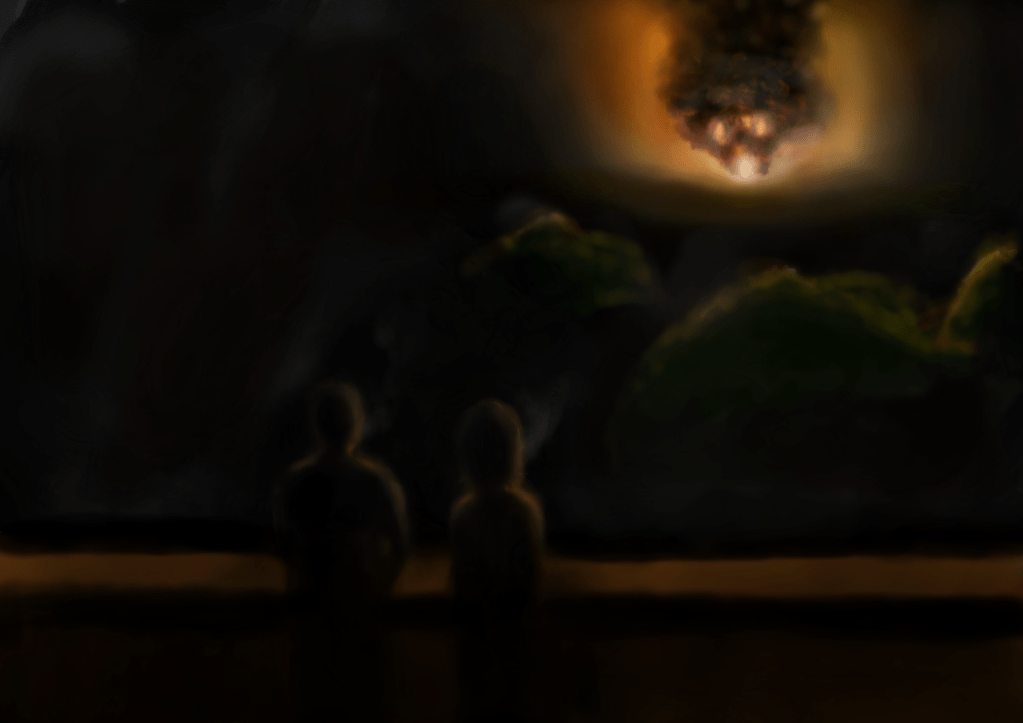
A smaller jet of fire shot up from where the fireball had appeared and then shrank back down. It would likely continue this flaming dance until all the gas in whatever tank had blown evaporated and burned.
“We should tell Howell,” Rivera said. She doubted the fireball had been heard inside the school, and with the boarded up windows she didn’t think anyone had been able to see the fire.
As they rushed back toward the hatch, she tried to reassure herself with the knowledge that this wouldn’t affect the school’s fuel supply, which came from a different gas station. But this was a short-lived comfort. The rising demand for gas would still be here, only now the total supply had been cut in half.
Those are finite resources and we’re living in a very finite world, she had told Ryan earlier, and that world had just become a lot more finite.
And something told her it wouldn’t take long for the looters who just lost their only source of fuel to set their sights on an alternative.
 The Blink